

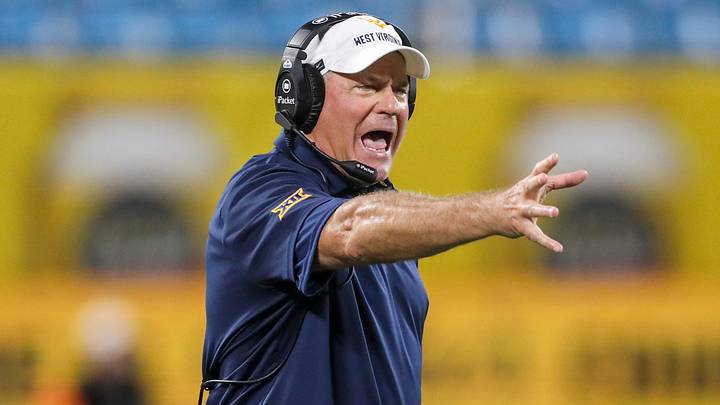
The West Virginia Mountaineers opened their Big 12 schedule with their first loss of the season on Saturday night, as Oklahoma State marched into a hostile environment in Milan Puskar Stadium and walked out with their first Big 12 win in over 1,000 days. The Cowboys looked dominant on offense, accumulating over 600 yards of offense. After the game, Rich Rodriguez pulled no punches about where things went wrong.
"Offensively we were moving okay, but defensively we didn't play well at all," Rodriguez said about the loss. "Didn't give our guys a chance. It's the head coach's responsibility to make sure we have a plan that can succeed, and it didn't succeed. So I didn't do a good job at making sure our plan was going to help us succeed."
Rich Rodriguez postgame press conference following WVU's 41-24 loss to Oklahoma State: pic.twitter.com/gEjy1MZPrJ
— Joe Brocato (@joebrowvm) September 27, 2026
"I don't think it was good the whole game...we definite did not play as fast [as last week]. Playing as hard I'll have to watch the film. But the plan we had failed, and that's pretty obvious. I'm the head coach, and I'm responsible to make sure our plans succeed or fail. So that falls on me. But the plan we had failed, for sure. I think that's obvious. 609 yards obvious."
But to understand that better, let's take a look at exactly what the Mountaineers were trying to do. Maybe we can gain some insight on exactly what the plan was, and why it failed, in Rich Rodriguez's words.
West Virginia's attempts to stop Drew Mestemaker backfire
West Virginia experimented with some sets that might best be described as a 3-2-6, with four safeties on the field multiple times throughout the night – on the first play of the night, nickel safety Geimere Latimer II, and safeties Andrew Powdrell, Kamari Wilson, and Da'Mare Williams were on the field for the Mountaineers in addition to starting corners Nick Taylor and Chams Diagne.
It was likely an attempt to overcompensate for Drew Mestemaker's dynamic passing abilities, particularly after a younger quarterback at a lower-level of FBS in Deuce Bailey diced up West Virginia's defense in Week 1. But here's the thing – it didn't work.
Despite often having extra help in the secondary, West Virginia did not cover Oklahoma State well at all. Mestemaker connected with wide receivers all night long that were absolutely wide open – so open that calling them 'wide open' feels like an understatement. Mestemaker completed 74% of his passes for 389 yards and three touchdowns.
On 27 pass plays, Taylor was targeted four times and gave up four receptions. Powdrell was targeted three times and gave up three receptions. Diagne and Wilson were targeted twice and gave up two receptions each. Linebacker Ben Cutter was targeted three times and allowed two receptions
And that poor performance was exacerbated when players young and/or inexperienced players such as Matt Sieg, Tim Roberson, and Kameron Reddic were subbed into the game due to the team already struggling, adding to the general chaos on that side of the ball at critical moments of the game, and at times giving up critical receptions.
Defensive front struggles: WVU football's defense 'never touched' Drew Mestemaker, couldn't stop the run
It may have been helpful to the secondary if the defensive front could have put Mestemaker under pressure, but with just five players among that group on many snaps, it was more difficult for those players to make that happen. The Mountaineers managed to earn quarterback hurries on seven of Mestemaker's 28 drop backs, and recorded just one quarterback hit and no sacks.
"We never touched [Mestemaker]," Rodriguez said. "He's a good passer and he's got great vision. He can make some great deep throws – guys were wide open – but when you don't pressure the guy at all as far as getting some pressure on him and let him get comfortable, good players like that, an NFL quarterback, is going to beat you."
And the whole point of playing the extra man in the secondary and one less in the defensive front is to stop Mestemaker. And while that didn't work, it also prevented the Mountaineers from doing something they've looked decent at doing early in the season – stopping the run.
The Cowboys racked up 220 yards on the ground against the Mountaineers, and the Caleb Hawkins tallied 180 yards and one touchdown on 31 carries. So now only did the Mountaineers not stop the biggest threat on the field, but their attempts to do so cost their defense in other facets of the game as well.
What comes next for West Virginia's defense?
You're not going to win Power 4 games consistently with a defense that allows 600 yards to an opponent, even if they have what might be an elite offense with an NFL quarterback. So something has to change. Rodriguez realizes that, and took accountability for that after the game.
Some people have accused defensive coordinator Zac Alley's defense of having too many moving parts, and the staff themselves talked about a lack of communication causing problems in the first two games.
Maybe making a 6-man secondary package the primary focus when it's not the normal base for West Virginia wasn't the best choice, and added to those issues. Maybe West Virginia just doesn't have the athletes to compete with Oklahoma State. But moving forward, something is going to have to change with West Virginia on the defensive side of the ball if they want to win games.
 Add us as a preferred source on Google
Loading recommendations... Please wait while we load personalized content recommendations