

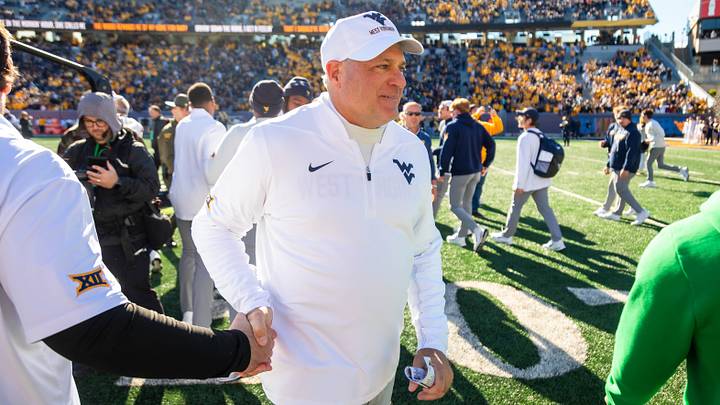
In the NIL and revenue share era of college football, with the transfer portal looming over the heads of every player and program each offseason, a lot of what goes into building the right roster is, for better or for worse, now based on financial incentives.
It's just the way the sport is, and there's not a lot anybody is going to be able to do to change that. Which makes it all the more difficult for a coach like Rich Rodriguez to institue his particular brand of locker room culture.
Rich Rodriguez wants a roster that feels an 'obligation' to West Virginia
On The Rich Rodriguez Show on Monday night, Rodriguez got off on a bit of a tangent about motivation for current college athletes, and he made it clear that he feels like the current era of college football is counter-productive to keeping players motivated to handle future challenges, both on-the-field as well as in everyday life.
"You like to think the motivation is there for every guy, but I think sometimes when a guy – I don't want to say money takes away some of the motivation, but it used to be that you wanted to go to college to make a better life for yourself," Rodriguez said.



"Whatever degree you got in, maybe you want to get to the NFL and get paid. Now these guys sometimes feel like they've already made it, and they haven't made it yet. That's the bad part about giving something before they have truly earned that much.
Rodriguez also was quick to share his philosophy on building a roster, which is a bit old-school and might be a bit antiquated in the modern era of college football. But that has made him no less committed to maintaining his standard.
"I want them to feel a certain obligation to West Virginia," Rodriguez said. "To our school, to our program, to our state. I don't want them to be hired guns, even if they only came for one year. I want them to feel like, 'I'm playing for West Virginia. I'm playing for my school, I'm playing for my state, and I'm playing for my teammates.'"
Rodriguez also slammed players who are willing to make a "business decision" that puts the athlete before the team, such as deciding not to go hard on a certain play, or to avoid making a tackle or taking a hit due to possible injury. Rodriguez said he'll make his own "business decision " to cut those types of players from his program.
How successful this approach can truly be in the modern era where the motivation for athletes has truly shifted so much at the collegiate level remains to be seen. But you can be certain that Rodriguez is going to do his level best to load his roster with players who want play for the state of West Virginia.
 Add us as a preferred source on Google