

When analyzing college football recruiting, the term often used to describe four-star or five-star recruits is "blue-chip." And in recent years, a formula created by national recruiting analyst Bud Elliott which he dubs the "Blue-Chip Ratio" has become an increasingly popular tool to distinguish which teams can be considered legitimate national championship contenders.
The formula is simple – the "Blue-Chip" Ratio simply calculates the percentage of blue-chip prospects on a team's roster. Elliott has posited that a team needs to be over 50% percent on the Blue-Chip Ratio, and since he began using that standard to evaluate teams in 2013, only one team has won a national championship without hitting 50% – last year's Indiana team, who managed to hit just eight percent.
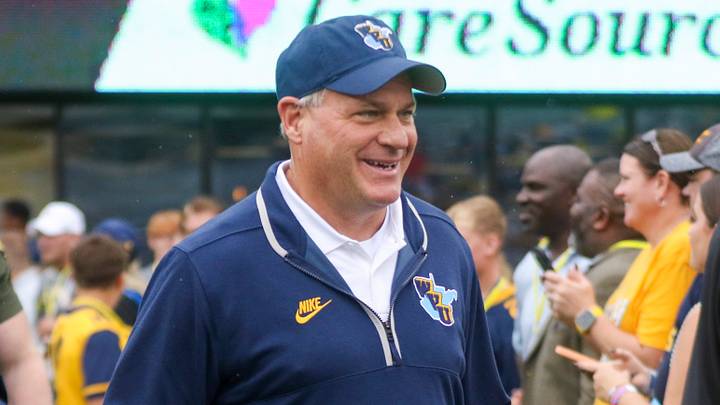
West Virginia has historically been a program that doesn't attract elite college football talent, and the program has always had to make due with less talent than the elite programs have. But with Rich Rodriguez back in charge of the program, it seems like he might be embarking on a project to fix that issue and raise the team's blue-chip ratio.
West Virginia's shocking amount of four-star talent on the 2026 roster
Before we start, let's make it clear that using the phrase "raising the blue-chip ratio" in relation to the argumentmade below isn't exactly accurate to Elliott's interpretation of his formula. That's because he doesn't yet include transfers in the forumla, as he awaits more definitive proof that transfers play a significant role in national championship success.
But I think there is a unique case to be made here for the Mountaineers. Let's start with te basic numbers, because there is a sneaky amount of four-star prospects hiding on West Virginia's roster in plain sight. In fact,there are 12 such players: Michael Hawkins Jr., Cam Cook, Amari Latimer, Taron Francis, Kevin Brown, Malik Agbo, Taylor Brown, Tobi Haastrup, Kamari Wilson, Jacob Bradford, Matt Sieg, and Vincent Smith
Take this for what it’s worth, depending upon how you feel about HS 🏈 ⭐️ rankings. But, according to On3, WVU will have 12 players on its ‘26 roster who were rated as 4⭐️s outta HS:
— Carson 🦊 (@Carson_Fox27)August 17, 2026
QB Michael Hawkins
RB Cam Cook
RB Amari Latimer
WR TaRon Francis
OL Malik Agbo
OL Kevin Brown
DL…
Now, four of theseare true freshmen, and one (Taylor Brown) is a sophomore who was recruited by West Virginia initially. The other seven are transfers: one, Malik Agbo, joined the team last offseason and stuck around. The other six are incoming transfers this season.
And in the case of three of those incoming transfers – Jacob Bradford, Taron Francis, and Tobi Haastrup, are sophomores who are one year removed from their initial high school recruiting rankings that redshirted at either Big Ten or SEC programs last year.
It's easier to view those players, in our opinion, as counting towards a formula like the blue-chip ratio than older transfers. After all, they are all much closer to the days of earning that four-star ranking, and haven't really gotten to the point in their college career where they've had the opportunity to prove that rankings were accurate.
And when you look at the total group of 12 former four-star prospects, seven of them (Kevin Brown, Cook, Francis, Hawkins, Latimer, Sieg, and Wilson) – are all true freshmen or incoming transfers who are expected to make an immediate impact this year. And Agbo and Smith have also been generating some buzz during camp.
So while it doesn't necessarily adhere to the strict blue-chip ratio formula that doesn't include transfers – and it's certainly much less than 50% of the total roster – there is clearly a strategy at play in which Rodriguez is gathering more consensus top talent than the program has stocked in a long time. And that will make it easier in the long run for the Mountaineers to get back to national prominence on the gridiron.
 Add us as a preferred source onGoogle
Loading recommendations... Please wait while we load personalized content recommendations